
'Nitish has no future in state politics.' 'Nitish harassed the Yadav community no end in his earlier tenure as chief minister. So who will the Yadav community vote for in the coming state elections?'
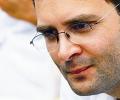
Though there is a full-throated clamour in the Congress that party vice-president Rahul Gandhi be formally named as its prime ministerial candidate for the 2014 Lok Sabha polls, the Nehru-Gandhi scion is personally not convinced that his projection will yield electoral dividends.

With the images of Rajendra Babu, Radhakrishnan, K R Narayanan, V V Giri and Kalam in my mind, the image of my beloved hero dancing ungainly to 'Merey angney main tumharra kya kaam hai', doesn't make a smooth transition, says Sudhir Bisht.

From planning Prime Minister Narendra Modi's foreign trips to playing a key role in the Jammu and Kashmir elections, former RSS spokesperson Ram Madhav is become increasingly important in the BJP

Sushma Swaraj's suave moves helped Narendra Modi pull off a diplomatic coup, helping regain her standing.
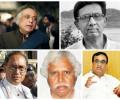
Disappointed and angry Congress members are likely to train their guns on Rahul Gandhi's team of advisors for inept handling of the 2014 Lok Sabha poll campaign, says Rediff.com contributor Anita Katyal

The Varanasi versus Azamgarh story is about the fears and insecurities of two of our strongest leaders, Narendra Modi and Mulayam Singh Yadav, says Sheela Bhatt.

'What will we drink if we start fearing these wells?'

'We have been getting e-mails for assignments and events. People from random islands, like Seychelles, called us to perform for India's independence day. It's crazy to see how the internet affects the world. We feel blessed that so many people recognise us. We have even got mails from low-budget feature film makers in the South -- like they want us to be the heroines!' Twins Poonam and Priyanka Shah give us a jhalak into their lives!

Desis in the US recall their earliest celebration of the festival of lights on American soil. Chaya Babu reports

Jayalalithaa's attack on BJP's PM hopeful a little too late in the coming, says N Sathiya Moorthy
.jpg)
Crony capitalism will of course generate investment and ensure profit for private capital, but it won't give employment or income to the people. If you can make money by selling coal or speculating in land, why produce electricity, why invest in research and development, why even set up factories, asks Praful Bidwai.

'The dirt in the Indian Ocean must be less than the abuses Narendra Modi got from secular forces.' 'If you are going to put the blame on the central government and the RSS for every wrongdoing, then it is not going to serve any purpose, rather it will complicate the issue instead of resolving it.' 'There are fringe elements in every society, but for an ideal State it is important to finish off the fringe elements.'

Atal Bihari Vajpayee would seek to placate the hawks in the RSS by stating that the writing of history should not be one-sided. At the same time, he would project a moderate 'Nehruvian' image of himself as the archetypal liberal politician who would strive to attain a balance between conflicting viewpoints. A fascinating profile of the former prime minister and Bharat Ratna by Paranjoy Guha Thakurta and Shankar Raghuraman.
